Nikos Katsikis, Renia Kagkou
The New World Capitals in Winy Maas (ed.) DOMUS 1037 (July – August 2019)
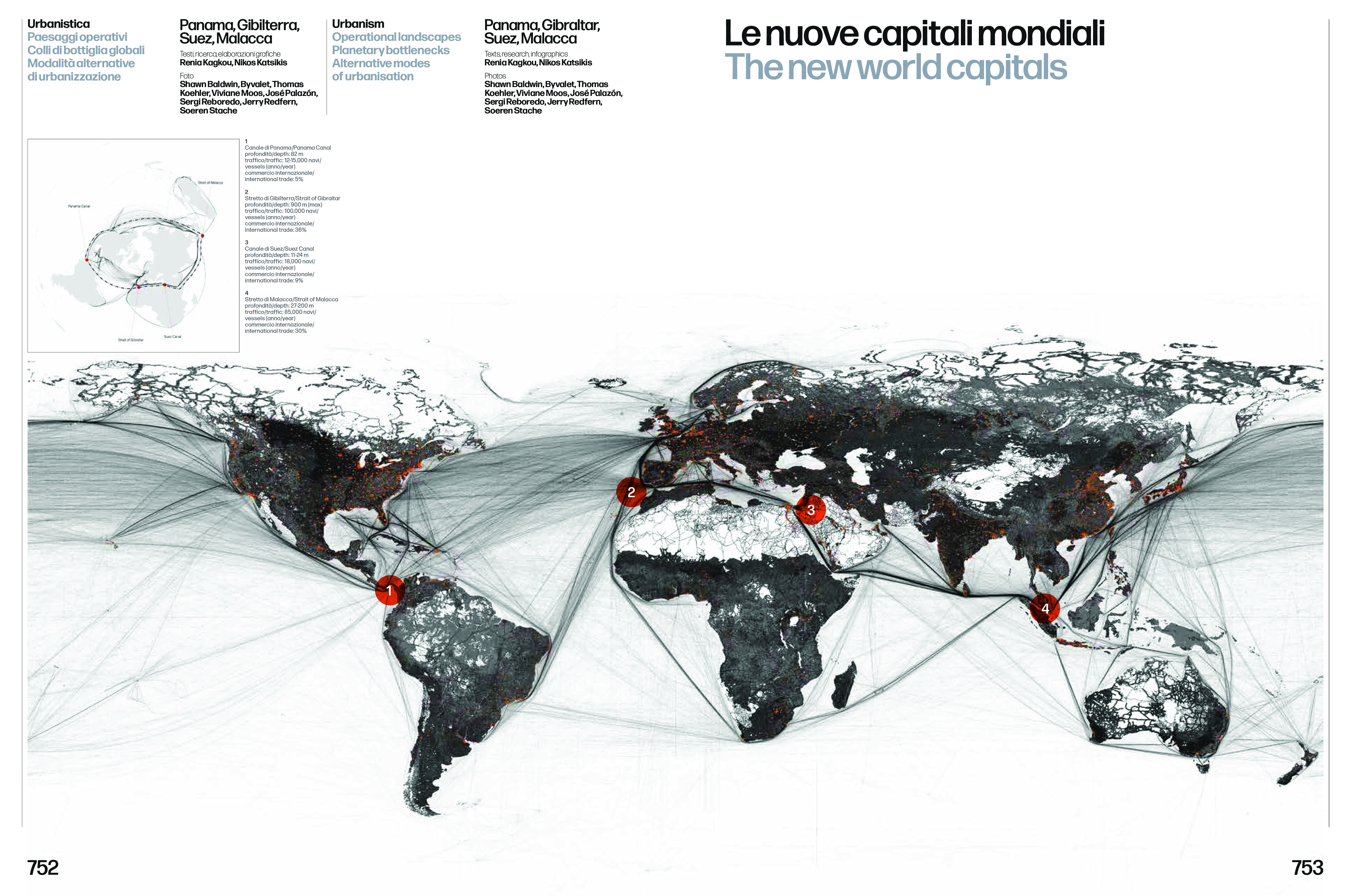
At the beginning of the 21st century, the planet is almost completely urbanized. Not just because of the unprecedented concentration of population and economic activity in larger and larger settlements, but also because of the extended biogeographical interdependencies that emerge out of it. In fact, if taken all together, human settlements cover no more than 3% of the earth’s land surface; yet they are responsible for the operationalization of more than 70% of the planetary terrain, which is currently used to support them: areas of primary production (agriculture, grazing, forestry, mining), circulation, and waste disposal, which also extend in the sea and sky across maritime and aviation corridors. These operational landscapes, largely constitute the metabolic basis of planetary urbanization, through which resources are extracted, commodities are circulated, and urban life is sustained. As the biogeographical interdependencies of urbanization are globalized, they become tightly interwoven with patterns of international trade, and the increasingly specialized landscapes of production and circulation across the globe. Yet they remain deeply grounded in the specificities of natural geography, revealing the material and environmental dependencies of the global system of flows.
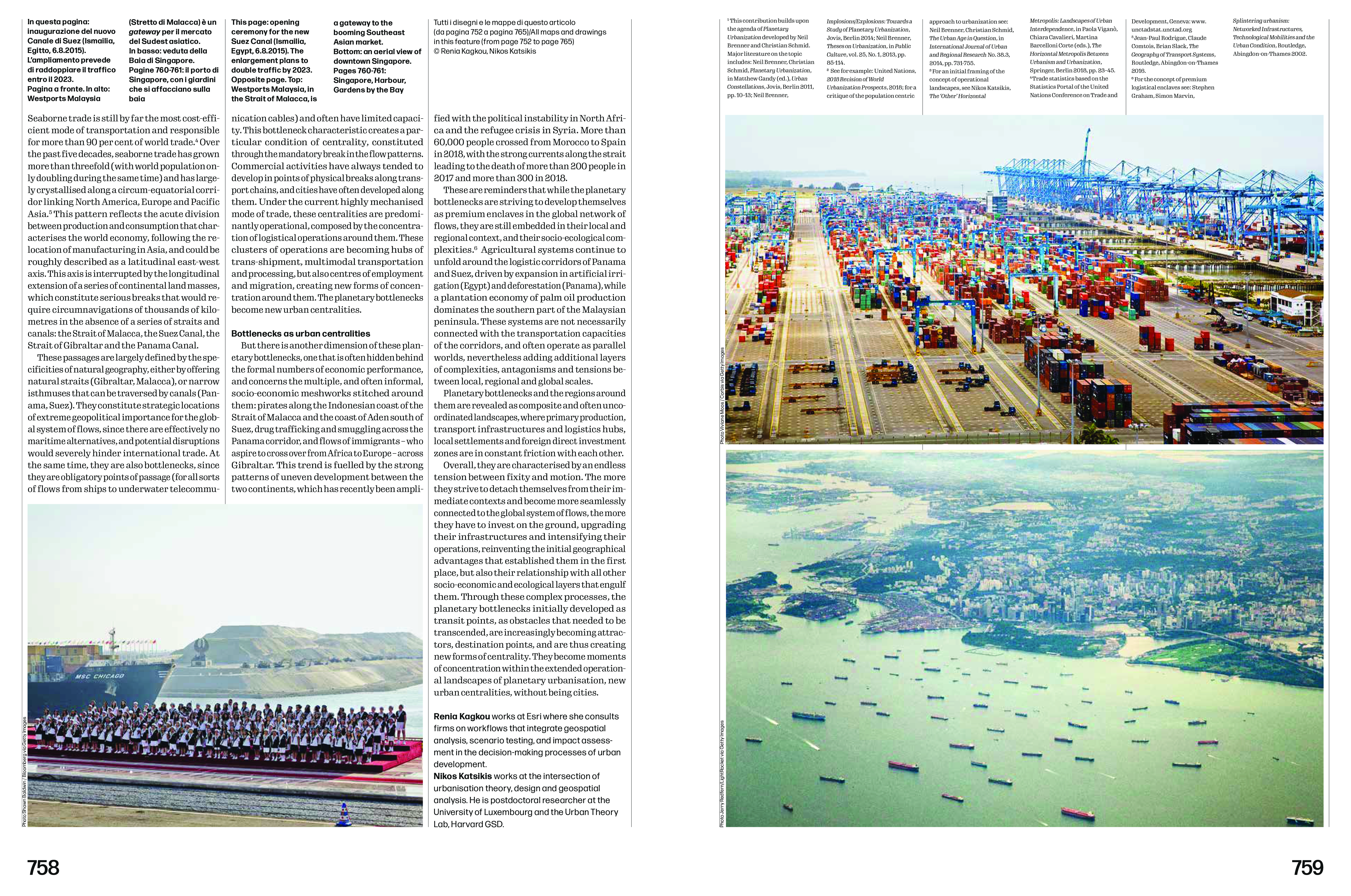
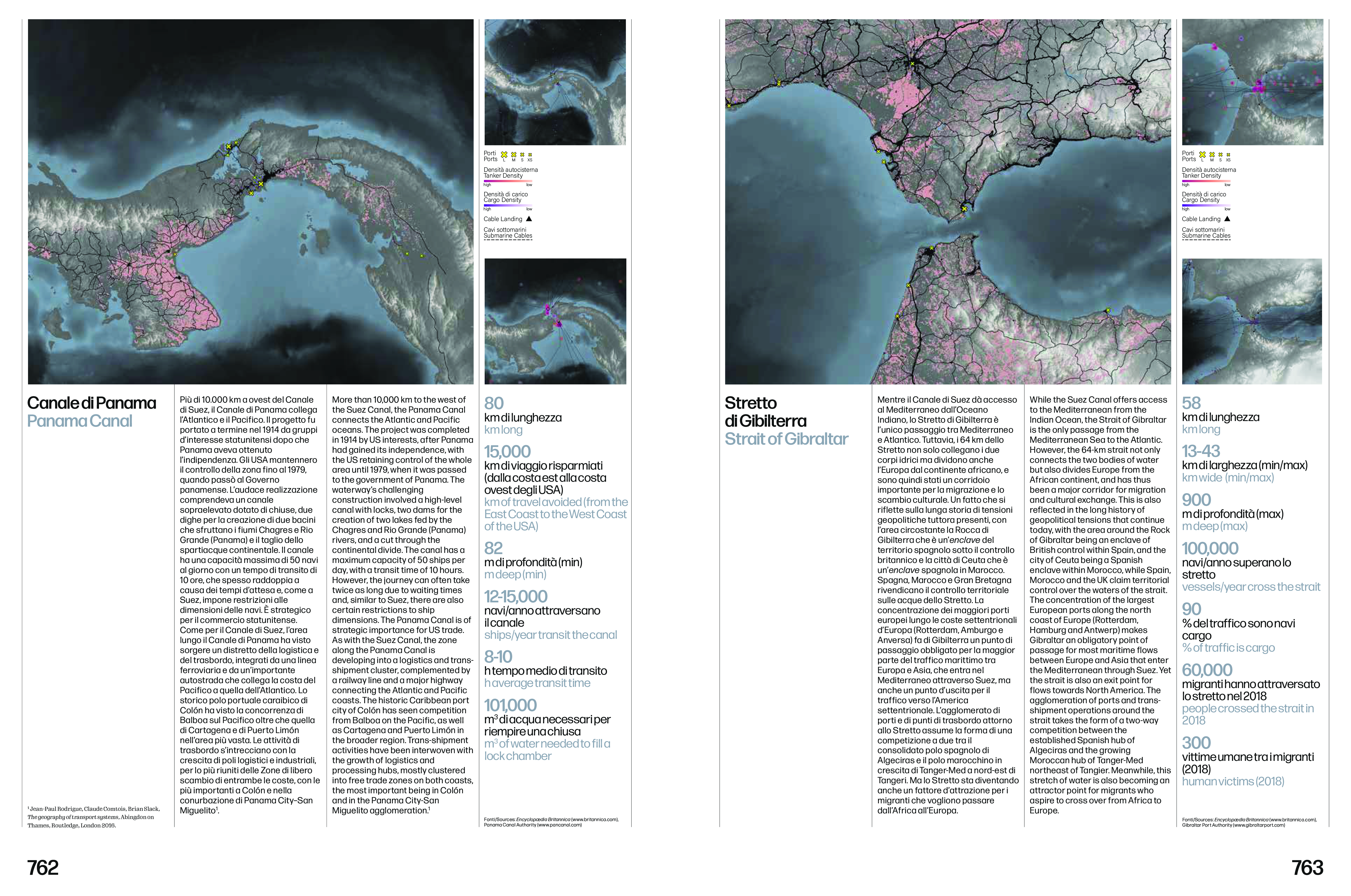
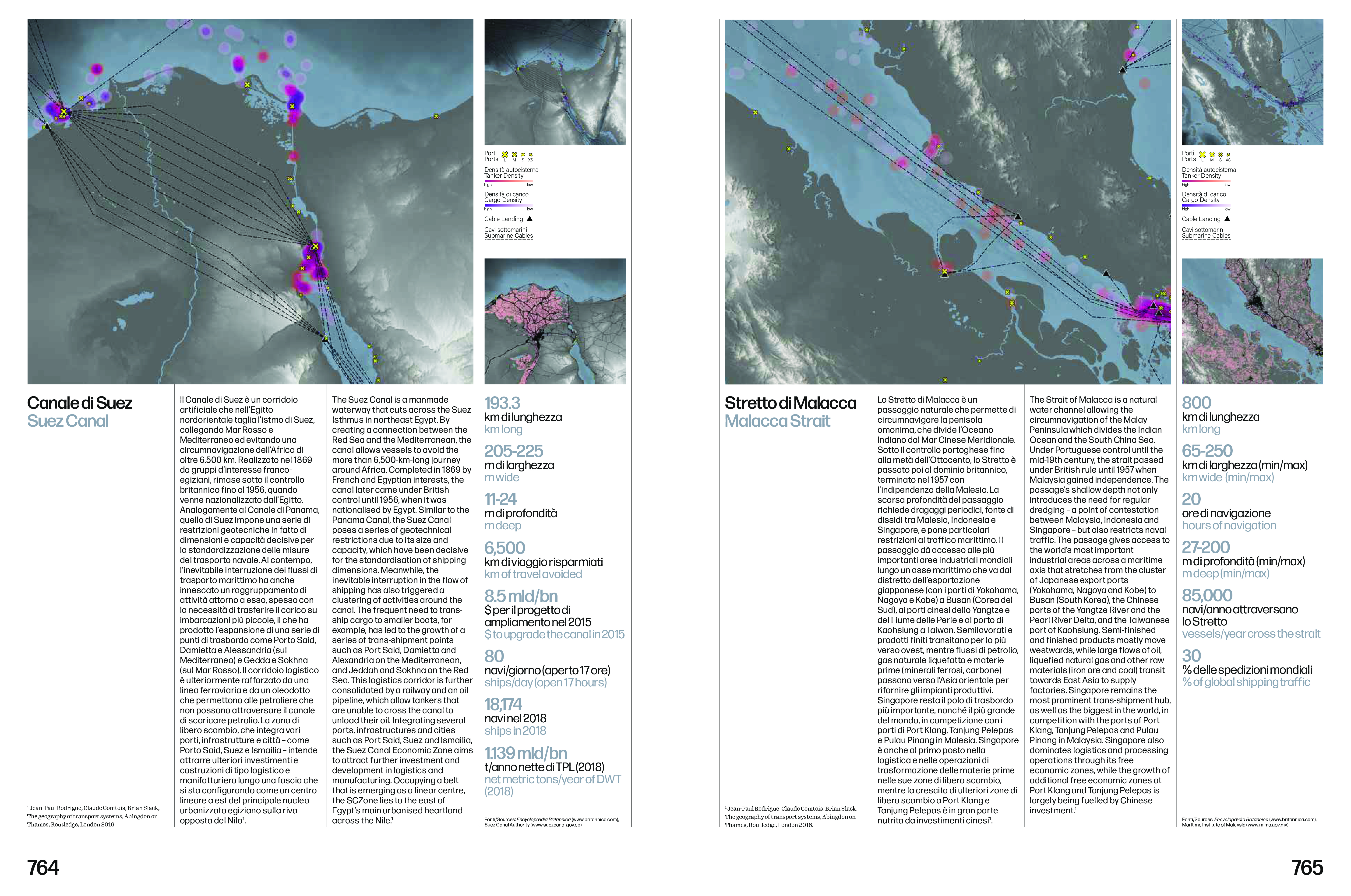
Within this context, certain operational landscapes become crystalized as strategic points in the planetary geography of urbanization. One exemplary case is the system of maritime passages located along the major maritime trade corridors, which accommodate more than 90% of global trade. Over the past decades, the major transoceanic routes have largely crystallized along a circum-equatorial corridor, linking North America, Europe and Pacific Asia. This latitudinal axis is interrupted by the longitudinal extension of a series of continental land masses, that would require circumnavigations of thousands of kilometers in the absence of a system of major straits and canals: the Malacca strait, the Suez canal, the Gibraltar strait, and the Panama canal. These passages constitute strategic points of extreme geopolitical importance for the global system of flows, since there are no effective alternatives. At the same time, they are also bottlenecks, since they are obligatory points of passage for all sorts of flows (from ships, to underwater telecommunication cables) and have often limited capacity. This bottleneck characteristic, creates a particular condition of centrality, creating around them clusters of operations and turning them into hubs of transshipment, multimodal transportation, and processing.
 Renia Kagkou